#16 James Rebanks The shepherd's life: a tale of the Lake District
This was a birthday present, and one I'd particularly asked for. James Rebanks is @HerdyShepherd1 on Twitter, and someone whose twitter feed I have enjoyed following for a while, with his lovely pictures of Herdwick sheep. Amusingly, the staff in Waterstones had trouble locating the one copy they'd apparently had in stock - eventually tracking it down to the Travel - Lake District section, when Autobiography would be more accurate! It's a great read, covering a lot I didn't know about sheep farming, particularly in that area, but also a lot more besides about education, and attitudes to incomers and perceptions of the Lake District.
#17 Elizabeth Jane Howard All change
Oh no, now I've finished the last one in her Cazalet chronicles series! :-( I have loved rediscovering these books (the previous four I read as a teenager) and then having the chance to finish it off with this final one. Set in 1956-1958 the book covers the declining fortunes of the Cazalet family in a much changed world. I love the glimpses of social history visible in these novels, and this one is no exception. Howard has a great talent for showing the different sides to all the characters.
#18 Pamela Druckerman French parents don't give in: 100 parenting tips from Paris
Follow up to her French children don't throw food, if you're interested in different cultural attitudes to parenting this is an hilarious read! No idea if it works, but it's very funny!
#19 Julian Fellowes Snobs
This is a portrayal of the modern class system, as Edith Lavery marries into the upper class and then quickly realises her mistake. Or was it a mistake. It took a bit to get into (this may have been because I started it in hospital during labour though so my mind wasn't totally on it) but I enjoyed the dry humour and insights immensely.
I've decided to stop writing book reviews for the time being, as I'm not getting as much reading time with LO here (Snobs took me six weeks to read!). I will be recording what I've read on LibraryThing though, although without reviews. I am quite pleased that I got through nearly 19 books in 2015 despite spending the majority of the year pregnant!
Showing posts with label books. Show all posts
Showing posts with label books. Show all posts
Sunday, March 13, 2016


Sunday, October 18, 2015
Books read 2015 #3
#11 Elizabeth Jane Howard Confusion
#12 Elizabeth Jane Howard Casting off
Books three and four from the Cazalet Chronicles, which I really enjoyed. I was rereading Confusion after first reading it about 20 years ago, and I think it was my first time reading Casting off? These two take the family through the war years and then to the immediate aftermath, where everything is a bit of an anticlimax. Having survived those years, the ending of the war doesn't mean the ending of problems, and, indeed, causes several relationships to need to be resolved. I particularly like the way chapters are written from the perspective of different members of the family, so you get to see situations from different angles.
#13 Margaret Hebblethwaite Motherhood and God
A slightly dated look at spirituality and motherhood. I struggled to understand why she couldn't take the baby to Mass with her, as most people I know quite happily breastfeed/bottle feed in church, but 30 years seems to have made quite a difference to attitudes! I liked the way she dwelt on the practical aspects of motherhood, as well as the spiritual, and the connection between the two.
#14 Heidi Eisenberg Murkoff What to expect when you're expecting
This seems to be a pretty ubiquitous pregnancy manual, so I got it from the library, but thought it was awful. Although this is the British edition, so the spellings are (mostly) British (this hasn't been thoroughly checked) and references to medical care are to the NHS, it still comes across as overwhelmingly American. There are confusing bits where the information seems to be more from a US medical point of view, than a British one. It's written in a really twee style, that mostly made me want to throw up (and no, that wasn't morning sickness) and instead of having straightforward sections of information is written in more of a 'problem page' style. I didn't find it particularly helpful.
#15 David Lagercrantz The girl in the spider's web
This is a continuation of Stieg Larsson's Millennium series, which has been written by someone else. Often this kind of sequel can be excruciating, but this one got good reviews so I thought it was worth a try, and I'm glad I did. I found the Millennium series compelling, partly because of the intriguing characters, partly because of finding out more about a different counry, and this continued those themes. It's not as long or as detailed as the first three books, but it still has the twists and turns, the further development of the characters. Definitely worth a read.
#12 Elizabeth Jane Howard Casting off
Books three and four from the Cazalet Chronicles, which I really enjoyed. I was rereading Confusion after first reading it about 20 years ago, and I think it was my first time reading Casting off? These two take the family through the war years and then to the immediate aftermath, where everything is a bit of an anticlimax. Having survived those years, the ending of the war doesn't mean the ending of problems, and, indeed, causes several relationships to need to be resolved. I particularly like the way chapters are written from the perspective of different members of the family, so you get to see situations from different angles.
#13 Margaret Hebblethwaite Motherhood and God
A slightly dated look at spirituality and motherhood. I struggled to understand why she couldn't take the baby to Mass with her, as most people I know quite happily breastfeed/bottle feed in church, but 30 years seems to have made quite a difference to attitudes! I liked the way she dwelt on the practical aspects of motherhood, as well as the spiritual, and the connection between the two.
#14 Heidi Eisenberg Murkoff What to expect when you're expecting
This seems to be a pretty ubiquitous pregnancy manual, so I got it from the library, but thought it was awful. Although this is the British edition, so the spellings are (mostly) British (this hasn't been thoroughly checked) and references to medical care are to the NHS, it still comes across as overwhelmingly American. There are confusing bits where the information seems to be more from a US medical point of view, than a British one. It's written in a really twee style, that mostly made me want to throw up (and no, that wasn't morning sickness) and instead of having straightforward sections of information is written in more of a 'problem page' style. I didn't find it particularly helpful.
#15 David Lagercrantz The girl in the spider's web
This is a continuation of Stieg Larsson's Millennium series, which has been written by someone else. Often this kind of sequel can be excruciating, but this one got good reviews so I thought it was worth a try, and I'm glad I did. I found the Millennium series compelling, partly because of the intriguing characters, partly because of finding out more about a different counry, and this continued those themes. It's not as long or as detailed as the first three books, but it still has the twists and turns, the further development of the characters. Definitely worth a read.
Sunday, August 16, 2015
Books read 2015 #2
#6 Pamela Cox and Annabel Hobley Shopgirls: true stories of friendship, hardship and triumph from behind the counter
I got this one from the library after meeting one of the authors when I was at work. It narrates the history of women working in shops from the mid-nineteenth century until the present day, and is full of little anecdotes and detail gleaned from the archives. I learnt a huge amount about social history, for instance, I'd had no idea that Sunday trading laws were a relatively new thing, and once upon a time shops used to be open very long hours to enable people who worked in factories etc to have a chance to shop. I think I'd been vaguely aware that shopgirls used to "live in", as a way of guarding their morals, and getting more work out of them for less money. It was also interesting to discover that the whole "demise of the high street" and move to big stores isn't a new thing, and the whole area of shopping has been in a state of flux ever since the nineteenth century!
#7 Deborah Cohen Family secrets: the things we tried to hide
This was another one I saw on the book suggestions pile near the self-issue machines in the library and picked it up as it looked interesting. It draws on archive material from the last 200 years to look at what families found shameful and how they tried to cover it up. So it looks at social attitudes, and how the law changed. It was really interesting seeing how things changed over time - Victorians were apparently happy to keep their disabled children in their midst, as they saw them as just one of those things and that they had a duty to look after them. But once the basic idea of genetics filtered through, having a disabled child indicated that something was wrong with your family so people (especially the middle and upper classes) were more inclined to hide them away in an institution. Obviously other attitudes changed over time too, including people having babies outside marriage, and whether adoption was OK or not (the changing ideas over whether or not children should know they are adopted were interesting too), and attitudes towards homosexuality, which was actually considered OK (even if illegal) most of the time, as long as people weren't too flamboyant about it. The book moves on to look at notions of privacy, and how they compare to now - once upon a time people tried to keep secrets within their family, whereas now people are more likely to share a lot of information via social media, but also be to be fiercely protective about what information search engines such as Google store.
#8 Julie Summers When the children came home: stories of wartime evacuees
In similar vein to the book above, this is another popular history type book, based on the accounts of wartime evacuees. It covers a lot of ground, looking at evacuation from the point of view of children and parents (plus people that went with the children, such as teachers), those that were evacuated to other countries, or evacuated from other parts of the world, and those for whom evacuation changed their lives in a positive way, and those who had an appalling time. It was a real eye-opener, as, of course, I knew children had been evacuated, but I had little idea of the logistics involved, or the different types of evacuation. From a 21st century perspective it sounds such a risky thing to do, to send children away to unvetted strangers, not knowing when you would see them again.
#9 Alan Titchmarsh Lawns, paths and patios
And now for something completely different! We're planning a garage extension and new patio/driveway so I thought I'd do some background research so got this from the library. It's fairly basic, but fills you in on all the basics you need to think about. It includes a lot of diagrams for how to do the work yourself, which we aren't intending to do, but it did help me to get an idea of what is involved in a project of this kind.
#10 Mary Gibson Custard tarts and broken hearts
Fiction set before and during the First World war, featuring the women who work in a custard factory in Bermondsey. I enjoyed the setting the scene and the attention to period detail. It's all a bit predictable, but an enjoyable read nonetheless.
I got this one from the library after meeting one of the authors when I was at work. It narrates the history of women working in shops from the mid-nineteenth century until the present day, and is full of little anecdotes and detail gleaned from the archives. I learnt a huge amount about social history, for instance, I'd had no idea that Sunday trading laws were a relatively new thing, and once upon a time shops used to be open very long hours to enable people who worked in factories etc to have a chance to shop. I think I'd been vaguely aware that shopgirls used to "live in", as a way of guarding their morals, and getting more work out of them for less money. It was also interesting to discover that the whole "demise of the high street" and move to big stores isn't a new thing, and the whole area of shopping has been in a state of flux ever since the nineteenth century!
#7 Deborah Cohen Family secrets: the things we tried to hide
This was another one I saw on the book suggestions pile near the self-issue machines in the library and picked it up as it looked interesting. It draws on archive material from the last 200 years to look at what families found shameful and how they tried to cover it up. So it looks at social attitudes, and how the law changed. It was really interesting seeing how things changed over time - Victorians were apparently happy to keep their disabled children in their midst, as they saw them as just one of those things and that they had a duty to look after them. But once the basic idea of genetics filtered through, having a disabled child indicated that something was wrong with your family so people (especially the middle and upper classes) were more inclined to hide them away in an institution. Obviously other attitudes changed over time too, including people having babies outside marriage, and whether adoption was OK or not (the changing ideas over whether or not children should know they are adopted were interesting too), and attitudes towards homosexuality, which was actually considered OK (even if illegal) most of the time, as long as people weren't too flamboyant about it. The book moves on to look at notions of privacy, and how they compare to now - once upon a time people tried to keep secrets within their family, whereas now people are more likely to share a lot of information via social media, but also be to be fiercely protective about what information search engines such as Google store.
#8 Julie Summers When the children came home: stories of wartime evacuees
In similar vein to the book above, this is another popular history type book, based on the accounts of wartime evacuees. It covers a lot of ground, looking at evacuation from the point of view of children and parents (plus people that went with the children, such as teachers), those that were evacuated to other countries, or evacuated from other parts of the world, and those for whom evacuation changed their lives in a positive way, and those who had an appalling time. It was a real eye-opener, as, of course, I knew children had been evacuated, but I had little idea of the logistics involved, or the different types of evacuation. From a 21st century perspective it sounds such a risky thing to do, to send children away to unvetted strangers, not knowing when you would see them again.
#9 Alan Titchmarsh Lawns, paths and patios
And now for something completely different! We're planning a garage extension and new patio/driveway so I thought I'd do some background research so got this from the library. It's fairly basic, but fills you in on all the basics you need to think about. It includes a lot of diagrams for how to do the work yourself, which we aren't intending to do, but it did help me to get an idea of what is involved in a project of this kind.
#10 Mary Gibson Custard tarts and broken hearts
Fiction set before and during the First World war, featuring the women who work in a custard factory in Bermondsey. I enjoyed the setting the scene and the attention to period detail. It's all a bit predictable, but an enjoyable read nonetheless.
Sunday, April 05, 2015
Books read 2015 #1
Can't believe it's taken me three months to read five books, although I have been doing a load of professional reading for work, which hasn't helped...
#1 John Pritchard How to pray
Borrowed this one from the church reading club, mainly because it looked interesting, short(!) and accessible, and I wasn't far off. It's actually taken me several months to read, mainly because all of the chapters look at a different way of praying and I needed time to absorb them, and to try some of them out. It's the kind of book I wish had been around about 20 years ago, as I'd have found it incredibly helpful as a new Christian. It still is incredibly helpful (there were a few, aha moments as I read it, when something I'd not understood before suddenly became clear - Ignatian prayer, for instance). A lot of it is about establishing a routine, finding out what works for you and slowing down enough for it to take effect. Highly recommended.
#2 Frances Hodgson Burnett The shuttle
I've owned this book since it was published in 2007, but have just never got round to reading it. It's quite chunky, and, as I usually have several books out from the library at a time, I frequently find it hard to fit in books I actually own. Originally published in 1907, it's a fictional account of an American heiress, Rosalie, who marries a minor member of the British aristocracy, principally so that her fortune can restore his house (think Cora's fortune and Downton Abbey). Except it doesn't turn out like that, as her new husband is distressed to discover that her money is under her control, rather than his. What follows is what would now be called domestic abuse. The shuttle in question is the shuttle weaving closer together both sides of the Atlantic, as these marriages become more common. Eventually her sister, Bettina, is old enough to travel to Britain to find out more, and much of the story is taken up with what happens next. I found it a compelling read, contrasting the dynamism and energy of the Americans, with the fairly useless and impoverished British upper classes. It's published by Persephone books, so is a very nice book to look at too!
#3 Elizabeth Jane Howard Marking time
The second book in the Cazalet Chronicles takes us into the Second World War, and the action shifts to follow the new generation of Cazalets, who are mostly in their teens. They all have their own worries, Christopher is a pacifist, Louise is desperate to be an actress, Polly is worried about what the adults aren't telling her, and Clary is worried about her father, after he goes missing in France. I love the detail that is observed in these books, from the details of dinners (particularly catering for a house of that size) to the difference the war makes to everyone's lives, the petty inconveniences, combined with moments when it comes closer to home.
#4 Margaret Attwood Maddaddam
The final part of the trilogy, started in Oryx and Crake and Year of the Flood, it fleshes out the story in the other two novels by giving a different perspective, and then moving the action on a little bit. I struggled a bit initially with what was happening, as it's a while since I read the first couple of novels (2004 and 2010 respectively, thanks LibraryThing!), and, although there is a short recap at the beginning, it still took quite a lot to jump into the dystopian world and have a vague idea what was going on. I did eventually get into it properly. It follows what happens after most of the population of the earth has been wiped out by a mysterious illness, and the few people who are left have to work out what they're doing. I didn't enjoy it as much as the other two - the idea is good, but it feels like it's now been overdone?
#5 Amy Bratley The girls' guide to homemaking
Chick-lit, with added sewing! ;-) This was being passed around at knitting group and I grabbed it to read as a bit of a change after the last book(!). It follows the usual chick-lit type saga, newly single girl can't work out what she's doing with her life, discovers a talent for making aprons (OK, that doesn't happen in most of them), falls over the man of her dreams (why does that always happen?) although she doesn't realise it at the time (again, they never do) and it all gets resolved in the end. Still, a fun read, although I get annoyed when they are so so unrealistic - since when has a single woman supporting herself by making aprons been able to buy a flat in Islington, even with a deposit?! But it's chick-lit, I'm not supposed to think about things like that!
#1 John Pritchard How to pray
Borrowed this one from the church reading club, mainly because it looked interesting, short(!) and accessible, and I wasn't far off. It's actually taken me several months to read, mainly because all of the chapters look at a different way of praying and I needed time to absorb them, and to try some of them out. It's the kind of book I wish had been around about 20 years ago, as I'd have found it incredibly helpful as a new Christian. It still is incredibly helpful (there were a few, aha moments as I read it, when something I'd not understood before suddenly became clear - Ignatian prayer, for instance). A lot of it is about establishing a routine, finding out what works for you and slowing down enough for it to take effect. Highly recommended.
#2 Frances Hodgson Burnett The shuttle
I've owned this book since it was published in 2007, but have just never got round to reading it. It's quite chunky, and, as I usually have several books out from the library at a time, I frequently find it hard to fit in books I actually own. Originally published in 1907, it's a fictional account of an American heiress, Rosalie, who marries a minor member of the British aristocracy, principally so that her fortune can restore his house (think Cora's fortune and Downton Abbey). Except it doesn't turn out like that, as her new husband is distressed to discover that her money is under her control, rather than his. What follows is what would now be called domestic abuse. The shuttle in question is the shuttle weaving closer together both sides of the Atlantic, as these marriages become more common. Eventually her sister, Bettina, is old enough to travel to Britain to find out more, and much of the story is taken up with what happens next. I found it a compelling read, contrasting the dynamism and energy of the Americans, with the fairly useless and impoverished British upper classes. It's published by Persephone books, so is a very nice book to look at too!
#3 Elizabeth Jane Howard Marking time
The second book in the Cazalet Chronicles takes us into the Second World War, and the action shifts to follow the new generation of Cazalets, who are mostly in their teens. They all have their own worries, Christopher is a pacifist, Louise is desperate to be an actress, Polly is worried about what the adults aren't telling her, and Clary is worried about her father, after he goes missing in France. I love the detail that is observed in these books, from the details of dinners (particularly catering for a house of that size) to the difference the war makes to everyone's lives, the petty inconveniences, combined with moments when it comes closer to home.
#4 Margaret Attwood Maddaddam
The final part of the trilogy, started in Oryx and Crake and Year of the Flood, it fleshes out the story in the other two novels by giving a different perspective, and then moving the action on a little bit. I struggled a bit initially with what was happening, as it's a while since I read the first couple of novels (2004 and 2010 respectively, thanks LibraryThing!), and, although there is a short recap at the beginning, it still took quite a lot to jump into the dystopian world and have a vague idea what was going on. I did eventually get into it properly. It follows what happens after most of the population of the earth has been wiped out by a mysterious illness, and the few people who are left have to work out what they're doing. I didn't enjoy it as much as the other two - the idea is good, but it feels like it's now been overdone?
#5 Amy Bratley The girls' guide to homemaking
Chick-lit, with added sewing! ;-) This was being passed around at knitting group and I grabbed it to read as a bit of a change after the last book(!). It follows the usual chick-lit type saga, newly single girl can't work out what she's doing with her life, discovers a talent for making aprons (OK, that doesn't happen in most of them), falls over the man of her dreams (why does that always happen?) although she doesn't realise it at the time (again, they never do) and it all gets resolved in the end. Still, a fun read, although I get annoyed when they are so so unrealistic - since when has a single woman supporting herself by making aprons been able to buy a flat in Islington, even with a deposit?! But it's chick-lit, I'm not supposed to think about things like that!
Saturday, January 03, 2015
Books read 2014 #5
#21 Matt Haig The Radleys
This was a chance find from the quick picks section at the library. Ostensibly it's about a middle class family living in the suburbs but it turns out things are not quite what they seem. I won't give away the plot, but it's all about secrets and repression, and finding a balancing act in life. I'm not actually sure what I thought about it. It's definitely not the book I thought I was going to read (I can't say why, as that will give it away). It was kind of quirky, kind of funny. Easily readable though.
#22 Emma Donoghue The sealed letter
I picked this book up in a little bookshop in Salisbury, where everything seemed to be discounted. I thought it looked quite interesting, but underestimated how much I'd get sucked into it, after a rather slow start. It's based on real-life happenings, the Victorian court case around the divorce of Helen Codrington, and her friendship with Emily Faithfull. The action is portrayed from various points of view, giving an insight into the motivations of all the characters - I was interested to find I could feel sympathetic towards Helen, even though her behaviour was often unbelievable. It is also a good reminder of how much things have changed for the better - Helen's husband retains control, "ownership" in those days, of their children after their divorce, and the children's welfare simply isn't taken into account.
#23 Lucy Lethbridge Servants: a downstairs view of twentieth-century Britain
Another purchase from the same little bookshop in Salisbury, this covers the history of being a servant, and attitudes towards servants, throughout the twentieth century. The chapters are in chronological order, but with some overlap, as obviously circumstances changed in servants' situations depending on whether they were employed in a big or small house. Some traditions in big houses continued long after things had changed in the rest of the country. It was a fascinating insight into attitudes towards class - how employers often couldn't understand why someone would rather work in a factory and live independently, than be in service, and how the changing demographics caused by the world wars gave more opportunities outside of service. The minutiae of the servants' lives was also fascinating. At the beginning of the century, the sheer number of people required to sustain the lives of the rich, who often didn't do a thing for themselves, was incredible. I also hadn't known about the 1911 Unemployment Insurance Act, which made it mandatory to have medical and unemployment insurance (the precursor to the NHS and the Welfare State), and the uproar this caused amongst both servants and their employers, with much misinformation doing the rounds. And, yet without this insurance, any ill servant was entirely dependent on the goodwill of their employer and was at serious risk of ending up in the workhouse. A really interesting insight into twentieth century history.
#24 Elizabeth Jane Howard The light years
And the last book provided a lot of background to this one! I originally read Elizabeth Jane Howard's Cazalet Chronicles about twenty years ago and decided to revisit them, after enjoying the Radio 4 adaptations over the last couple of years. This is the first novel, and I found a lot there that I either missed the first time round or just hadn't remembered. I don't think I had appreciated how she delves into the different aspects of so many people's lives, both servants and the family. I think, on first reading, I had assumed the family were upper-class, but they are actually somewhere in the middle, and earn their income from 'trade', so aren't hanging out with the poshest of the posh. You get to see events from a lot of different perspectives, and I love how she captures all the point of view, particularly that of the children in the years leading up to the Second World War. Have now got the next one reserved at the library.
So, that's 24 books read in 2014. What did you enjoy reading last year? I hope I've inspired some people to go and read some of the books or authors I've mentioned.
This was a chance find from the quick picks section at the library. Ostensibly it's about a middle class family living in the suburbs but it turns out things are not quite what they seem. I won't give away the plot, but it's all about secrets and repression, and finding a balancing act in life. I'm not actually sure what I thought about it. It's definitely not the book I thought I was going to read (I can't say why, as that will give it away). It was kind of quirky, kind of funny. Easily readable though.
#22 Emma Donoghue The sealed letter
I picked this book up in a little bookshop in Salisbury, where everything seemed to be discounted. I thought it looked quite interesting, but underestimated how much I'd get sucked into it, after a rather slow start. It's based on real-life happenings, the Victorian court case around the divorce of Helen Codrington, and her friendship with Emily Faithfull. The action is portrayed from various points of view, giving an insight into the motivations of all the characters - I was interested to find I could feel sympathetic towards Helen, even though her behaviour was often unbelievable. It is also a good reminder of how much things have changed for the better - Helen's husband retains control, "ownership" in those days, of their children after their divorce, and the children's welfare simply isn't taken into account.
#23 Lucy Lethbridge Servants: a downstairs view of twentieth-century Britain
Another purchase from the same little bookshop in Salisbury, this covers the history of being a servant, and attitudes towards servants, throughout the twentieth century. The chapters are in chronological order, but with some overlap, as obviously circumstances changed in servants' situations depending on whether they were employed in a big or small house. Some traditions in big houses continued long after things had changed in the rest of the country. It was a fascinating insight into attitudes towards class - how employers often couldn't understand why someone would rather work in a factory and live independently, than be in service, and how the changing demographics caused by the world wars gave more opportunities outside of service. The minutiae of the servants' lives was also fascinating. At the beginning of the century, the sheer number of people required to sustain the lives of the rich, who often didn't do a thing for themselves, was incredible. I also hadn't known about the 1911 Unemployment Insurance Act, which made it mandatory to have medical and unemployment insurance (the precursor to the NHS and the Welfare State), and the uproar this caused amongst both servants and their employers, with much misinformation doing the rounds. And, yet without this insurance, any ill servant was entirely dependent on the goodwill of their employer and was at serious risk of ending up in the workhouse. A really interesting insight into twentieth century history.
#24 Elizabeth Jane Howard The light years
And the last book provided a lot of background to this one! I originally read Elizabeth Jane Howard's Cazalet Chronicles about twenty years ago and decided to revisit them, after enjoying the Radio 4 adaptations over the last couple of years. This is the first novel, and I found a lot there that I either missed the first time round or just hadn't remembered. I don't think I had appreciated how she delves into the different aspects of so many people's lives, both servants and the family. I think, on first reading, I had assumed the family were upper-class, but they are actually somewhere in the middle, and earn their income from 'trade', so aren't hanging out with the poshest of the posh. You get to see events from a lot of different perspectives, and I love how she captures all the point of view, particularly that of the children in the years leading up to the Second World War. Have now got the next one reserved at the library.
So, that's 24 books read in 2014. What did you enjoy reading last year? I hope I've inspired some people to go and read some of the books or authors I've mentioned.
Sunday, November 30, 2014
My birthday (a while ago now)
So, back in October, I had a birthday, but, as I said in my last post, life was a bit busy for a while so I never got round to blogging about it. Ever wondered what Slough station looks like at 8am on a Sunday? Almost totally deserted. This was when I had to head over to Bristol for a work conference and, of course, there was engineering work on our railway line that weekend with rail replacement buses on instead, so it seemed easier to drive to Slough and go from there...

Anyway, that is now all finished, and I'm getting caught up with all the time off in lieu that I managed to accumulate in the early part of November. So, my birthday? Well, you've already seen the plant purchases, from our lunch and afternoon out to the garden centre.
Then I got some fabulously cool presents. The crafty ones are here. The OH got me some blocking mats, which are already proving useful for pinning things out for blocking. I like being able to use just a few of them to block a small item, or the whole thing for something big. A friend gave me a make a bag kit, which I'm looking forward to trying as I want to do more sewing.

These are the other ones (I also got a new dress, but I haven't got a picture of that!). The Borgen box set - we really enjoyed the first series but recorded it then waited ages to start watching it. It turned out that the final episode was only partially recorded so We Couldn't Find Out What Happened - really annoying! Anyway, this meant we could finish watching the first series, and then get going with the next two series. And the book about the Magna Carta and Lincoln, cos, you know, Magna Carta is going to be big next year. Oh, and a Montezuma chocolate library!
 It was a lovely birthday, even though it feels like a long time ago now... We'd thought about trying to have a holiday the week of my birthday, but we couldn't quite coordinate getting the same week off work, so our few days in Salisbury ended up being a couple of weeks before it.
Anyway, that is now all finished, and I'm getting caught up with all the time off in lieu that I managed to accumulate in the early part of November. So, my birthday? Well, you've already seen the plant purchases, from our lunch and afternoon out to the garden centre.
Then I got some fabulously cool presents. The crafty ones are here. The OH got me some blocking mats, which are already proving useful for pinning things out for blocking. I like being able to use just a few of them to block a small item, or the whole thing for something big. A friend gave me a make a bag kit, which I'm looking forward to trying as I want to do more sewing.
These are the other ones (I also got a new dress, but I haven't got a picture of that!). The Borgen box set - we really enjoyed the first series but recorded it then waited ages to start watching it. It turned out that the final episode was only partially recorded so We Couldn't Find Out What Happened - really annoying! Anyway, this meant we could finish watching the first series, and then get going with the next two series. And the book about the Magna Carta and Lincoln, cos, you know, Magna Carta is going to be big next year. Oh, and a Montezuma chocolate library!
Thursday, October 16, 2014
Books read 2014 #4
#16 Emma Healey Elizabeth is missing
Another book I saw in a bookshop on holiday, then ordered from the library! This is a murder mystery story, but with a difference, as the main character has dementia. I thought the author did a pretty good job of describing how bewildering it must be from the point of view of the person with dementia, who is trying to find out where her friend Elizabeth has gone, but no one seems to care that she is missing. The action jumps between the present-day, and her childhood, when her sister also went missing. Intriguing angle for a story, and it kept me captivated anyway.
#17 Andrew Atherstone Archbishop Justin Welby: the road to Canterbury
This is a shortish biography of Justin Welby, published just as he became Archbishop of Canterbury. I don't agree with all of his views, but I like what he's done so far as Archbishop and I think he could be a very positive force, so this seemed like a good idea to read. It did help me fill in a lot of the background to things that I'd read in the media. It covers everything, from childhood, through to Archbishop, explaining things along the way, such as his education and how he came to faith and what he did before ordination, and got involved in various initiatives at the churches he worked at after ordination. A good introduction, which has given me the background to help understand more about what I read elsewhere! It's written in a very readable way, and only took me a week to read, so well worth dipping into.
#18 Stephanie Pearl-McPhee Free-range knitter: the Yarn Harlot writes again
Another amusing collection of anecdotes from the Yarn Harlot. These are the perfect thing to dip into at the end of a long day. Some observations are longer than others, and some are tinged with sadness, as well as amusement.
#19 Clara Parkes The yarn whisperer: reflections on a life in knitting
Borrowed this from a friend, and it was read almost overnight when I couldn't get any sleep when I had a cold. It's in a similar vein to the Yarn Harlot books - reflections on knitting, and is a very enjoyable read.
#20 Wendy Moore Wedlock: how Georgian Britain's worst husband met his match
This was from a display of books by the issue computer at the library, which I picked up as the title intrigued me and ended up borrowing. It's the biography of Mary Eleanor Bowes and was fascinating. Mary Bowes wasn't someone I'd heard of before (she is actually an ancestor of the Queen Mother, and I'd heard of the Bowes Museum). She was an incredibly wealthy girl, who was married twice, neither time particularly well, but the second was a disaster, when she married a fraudster and experienced what we would now recognise as domestic violence. In those days women had very few rights, and weren't allowed to own property (it passed directly to their husband on marriage), but Mary managed to pull off the almost impossible and get a divorce. It was interesting finding out how the very beginnings of equal rights for women began, and made me very glad I live now!
Another book I saw in a bookshop on holiday, then ordered from the library! This is a murder mystery story, but with a difference, as the main character has dementia. I thought the author did a pretty good job of describing how bewildering it must be from the point of view of the person with dementia, who is trying to find out where her friend Elizabeth has gone, but no one seems to care that she is missing. The action jumps between the present-day, and her childhood, when her sister also went missing. Intriguing angle for a story, and it kept me captivated anyway.
#17 Andrew Atherstone Archbishop Justin Welby: the road to Canterbury
This is a shortish biography of Justin Welby, published just as he became Archbishop of Canterbury. I don't agree with all of his views, but I like what he's done so far as Archbishop and I think he could be a very positive force, so this seemed like a good idea to read. It did help me fill in a lot of the background to things that I'd read in the media. It covers everything, from childhood, through to Archbishop, explaining things along the way, such as his education and how he came to faith and what he did before ordination, and got involved in various initiatives at the churches he worked at after ordination. A good introduction, which has given me the background to help understand more about what I read elsewhere! It's written in a very readable way, and only took me a week to read, so well worth dipping into.
#18 Stephanie Pearl-McPhee Free-range knitter: the Yarn Harlot writes again
Another amusing collection of anecdotes from the Yarn Harlot. These are the perfect thing to dip into at the end of a long day. Some observations are longer than others, and some are tinged with sadness, as well as amusement.
#19 Clara Parkes The yarn whisperer: reflections on a life in knitting
Borrowed this from a friend, and it was read almost overnight when I couldn't get any sleep when I had a cold. It's in a similar vein to the Yarn Harlot books - reflections on knitting, and is a very enjoyable read.
#20 Wendy Moore Wedlock: how Georgian Britain's worst husband met his match
This was from a display of books by the issue computer at the library, which I picked up as the title intrigued me and ended up borrowing. It's the biography of Mary Eleanor Bowes and was fascinating. Mary Bowes wasn't someone I'd heard of before (she is actually an ancestor of the Queen Mother, and I'd heard of the Bowes Museum). She was an incredibly wealthy girl, who was married twice, neither time particularly well, but the second was a disaster, when she married a fraudster and experienced what we would now recognise as domestic violence. In those days women had very few rights, and weren't allowed to own property (it passed directly to their husband on marriage), but Mary managed to pull off the almost impossible and get a divorce. It was interesting finding out how the very beginnings of equal rights for women began, and made me very glad I live now!
Saturday, July 26, 2014
Books read 2014 #3
Having been back in my last books read update and read a book I enjoyed back in the Dark Ages when I was young, I found second-hand copies of some books I enjoyed as a teenager via Abebooks.
#11 Liz Berry Mel
It turned out that I had managed to remember Mel and The China garden as one book, which isn't the case, although having now re-read both of them I remember why I enjoyed both. Funny what the brain remembers 20 years down the line, isn't it?
Mel is about somebody called, funnily enough, Mel, a 17 year old whose Mum has just had a breakdown and who decides to redecorate their house over the summer. Which doesn't sound that exciting, but I found it quite inspirational at the time, I seem to remember. So, it's about a seventeen-year-old who turns her life around and sorts out her career, and does it on her own (although there a couple of love interests, she isn't dependent on them, which makes for a refreshing change in books) with a bit of help from her friends. I seem to have completely missed the predatory school teacher though when I originally read it!
#12 Liz Berry The China garden
The China garden also features a teenager, Clare, who moves with her mother to an ancient English estate, where strange things start to happen. She slowly unlocks the secret behind the myths around the place, and discovers the meaning of the China gardens. I found this totally compelling as a teenager, and loved the mixture of mystery and history woven into the story. Funnily enough it arrived on time to take on holiday with us in June, and it turned out we were heading to the same sort of area in which the novel is set!
#13 100 gardening questions answered
This is a compilation of gardening questions from Gardeners' World magazine, which the OH saw in WHSmith and bought for me. It's grouped into sections covering In your garden, techniques and problems and I've found it quite useful to dip in and out of.
#14 Liz Trenow The forgotten seamstress
I saw a copy of this book in a bookshop on holiday and thought it sounded interesting, but I get most of my fiction from the library (sorry, bookshop) so I popped online and reserved a copy to read when I got home again. A woman called Caroline discovers a quilt in her mother's attic and tries to find out more about it. Caroline's modern day story (fairly chick lit standard of girl in a mess looking for boy, finds boy, but with added quilting) is interspersed with the story of Maria, who created the quilt and who worked at Buckingham Palace and, ahem, caught the eye of the Prince of Wales. It is quite predictable, but it's a good read and I enjoyed the quilting stuff, although I don't know how realistic that is as I'm not a quilter myself...
#15 Julian Fellowes Past Imperfect
This was a chance find at the library, as it was on a display near the self-issue terminal as I took another book out and I ended up taking this out as well. It covers two periods of time, the Season in the 1960s, looked at from the perspective of someone who knows that way of life is coming to an end, and forty years later as the characters consider the consequences of their actions then. It took a while to get into it, and the ending wasn't altogether a surprise, but I found all the class snobbery amusing, with plenty of detail included. The story revolves around the central character, who is contacted by his enemy of forty years earlier, who is now dying. It turns out that this man conceived a child back then and now needs to track down his heir to leave his fortune to.
Sunday, July 06, 2014
Books read 2014 #2
#6 Jambusters: the story of the Women's Institute in the Second World War by Julie Summers
This is one I picked up from a display at my local library. It's a very readable history (although it does include notes, bibliography and index should you want them), starting with an introductory chapter about how and why the WI was started - this answered the question of why I've never found a WI near most of the places I've lived (they were in villages, not cities). Subsequent chapters cover different aspects of their work, from the early years of the war when villages had to adapt quickly to take in evacuee children and teachers coming from the cities, to a more thematic approach covering crafts, cooking, growing vegetables and also the influence they had on government. I found it really interesting.
#7 Shrubs and small trees: simple steps to success by Simon Akeroyd
#8 Planting with trees by Andrew & Rosamond McIndoe
These two are again from the library, and are a perfect example of why libraries are brilliant - there's no way I'd have bought two books about trees just to help us choose a suitable tree for a space in our garden, and other than the RHS Plant Selector, information online tends towards the patchy. Both books are at the introductory level, covering various aspects of using trees in the garden. Both include recommendations for differently sized trees and particular aspects/soil types.
#9 Fly-by-night by K.M. Peyton
This is a book I loved when I was about ten, and when I came across it again I couldn't resist re-reading it. It's all about a girl called Ruth who is desperate to have a pony, and buys an unbroken one. Back when I first read it everything but the pony stuff must have washed over me, but I was struck by how much concern there is in the book for the family's economic situation, their struggles to pay the mortgage (a whole £5 a week, which did give me the giggles) etc. And also the freedom for Ruth, who is only eleven at the start of the book, yet goes hitch-hiking and wanders the country lanes all on her own!
Have any of you gone back to read a book you loved as a child and re-read it as an adult? How did you find it?
#10 The detective's daughter by Lesley Thomson
Another one from Greensideknits list from a while back. Basically a detective dies very suddenly and his daughter (rather implausibly) goes ahead and solves the murder from years back that's at the centre of the story. It was an interesting read, and I liked the different approach (even though it wasn't totally believable). It also featured a lot of parts of London I know well, which added an extra level to it.
This is one I picked up from a display at my local library. It's a very readable history (although it does include notes, bibliography and index should you want them), starting with an introductory chapter about how and why the WI was started - this answered the question of why I've never found a WI near most of the places I've lived (they were in villages, not cities). Subsequent chapters cover different aspects of their work, from the early years of the war when villages had to adapt quickly to take in evacuee children and teachers coming from the cities, to a more thematic approach covering crafts, cooking, growing vegetables and also the influence they had on government. I found it really interesting.
#7 Shrubs and small trees: simple steps to success by Simon Akeroyd
#8 Planting with trees by Andrew & Rosamond McIndoe
These two are again from the library, and are a perfect example of why libraries are brilliant - there's no way I'd have bought two books about trees just to help us choose a suitable tree for a space in our garden, and other than the RHS Plant Selector, information online tends towards the patchy. Both books are at the introductory level, covering various aspects of using trees in the garden. Both include recommendations for differently sized trees and particular aspects/soil types.
#9 Fly-by-night by K.M. Peyton
This is a book I loved when I was about ten, and when I came across it again I couldn't resist re-reading it. It's all about a girl called Ruth who is desperate to have a pony, and buys an unbroken one. Back when I first read it everything but the pony stuff must have washed over me, but I was struck by how much concern there is in the book for the family's economic situation, their struggles to pay the mortgage (a whole £5 a week, which did give me the giggles) etc. And also the freedom for Ruth, who is only eleven at the start of the book, yet goes hitch-hiking and wanders the country lanes all on her own!
Have any of you gone back to read a book you loved as a child and re-read it as an adult? How did you find it?
#10 The detective's daughter by Lesley Thomson
Another one from Greensideknits list from a while back. Basically a detective dies very suddenly and his daughter (rather implausibly) goes ahead and solves the murder from years back that's at the centre of the story. It was an interesting read, and I liked the different approach (even though it wasn't totally believable). It also featured a lot of parts of London I know well, which added an extra level to it.
Sunday, March 23, 2014
Books read 2014#1
I'm going to attempt to keep track of all the books I read this year... although not sure how long I'll manage to keep it up for! I generally track what I've read using LibraryThing, which you can see in the blog sidebar. I'm definitely not reading as much as I did when I was a London commuter, with a three hour commute every day - I was getting through 1.5 books a week then, as well as a daily paper and a weekly one! Now I seem to have managed 6 books in 12 weeks, not so good...
#1 City of the mind by Penelope Lively
This was slow to get started, but I was eventually absorbed by it. It's about an architect in London in the 1980s, who has just got divorced. It's all about how he makes a future for himself, but is much more than that as there are echoes of London through the ages in the places he goes to. As London is a place where I've lived, worked and studied I enjoyed reading about places I know, many of which I now have a different perspective on.
#2 Square metre gardening by Mel Bartholomew
This is an introduction to square metre gardening, and covers everything from why you'd want to do it, constructing raised beds and accessories to planting them. I thought it would be a very useful book, but it's written in a really patronising style, and the author makes it sound like he knows everything (perhaps he does, but it didn't come across very well). He also uses peat, which I don't agree with. Although it is written for a British audience (courgettes and aubergines!), it does read like the author is used to vast spaces for gardens - I thought this was a method for saving space, and it is, but there doesn't seem to be much content for the gardener who can only fit one or two of these raised beds in. Presumably it's based on his square foot gardening books, written for an American audience? It does have very clear illustrations however, and if you want to construct raised beds from scratch this would be a good place to start.
#3 Faithless by Karin Slaughter
I read a review of this by Greensideknits, then happened to see a copy at the library so picked it up. It's a fast paced thriller, about a police chief sort of married to a doctor/coroner who happen to find the body of a young girl buried in a box in the forest, and who appears to have been buried alive. I haven't read anything else featuring the same characters, so did have a few problems keeping up with who was who in the plot, but it's an interesting read.
#4 The Lady of the Rivers by Phillipa Gregory
This is the story of Jacquetta of Luxembourg, the mother of Elizabeth Woodville, and so fills in a lot of the background to The White Queen. It's an interesting historical novel, and not a period of history I'm that familiar with, but I kind of wish I could have read it before doing A Level History as it helped me untangle what was going on before the Wars of the Roses (my A Level syllabus started with the Tudors). As usual Gregory focuses on what is happening to the women, so there isn't as much boring stuff about battles which you get in some historical writing. I thought she portrays the uncertainties of the time very well, and the pulls on the loyalty of the people.
#5 The Rosie project by Graeme Simsion
Don is a genetics professor working in an Australian university. He also probably has Asperger's Syndrome. The Rosie project is the hilarious story of how he attempts to find the perfect partner, and how he meets Rosie, who really doesn't appear to be compatible with him at all. I really enjoyed reading this. Serious subject matter, but dealt with very well, and with a great deal of humour.
#6 Planting plans for your kitchen garden: how to create a vegetable, herb and fruit garden in easy stages by Holly Farrell
A very clearly laid out, methodical book, that provides plans for a variety of modular vegetable, fruit and herb growing layouts. There are plans for all kinds of gardeners, from the serious grower, with plenty of time and space, to those just wanting to make the most of the amount of space they have. It also takes into account soil type, what sort of produce you might want to grow, and growing to encourage wildlife and pollinators. I found this incredibly helpful (it's much better than the Bartholomew book I reviewed above), and easily adapted to your own gardening circumstances.
#1 City of the mind by Penelope Lively
This was slow to get started, but I was eventually absorbed by it. It's about an architect in London in the 1980s, who has just got divorced. It's all about how he makes a future for himself, but is much more than that as there are echoes of London through the ages in the places he goes to. As London is a place where I've lived, worked and studied I enjoyed reading about places I know, many of which I now have a different perspective on.
#2 Square metre gardening by Mel Bartholomew
This is an introduction to square metre gardening, and covers everything from why you'd want to do it, constructing raised beds and accessories to planting them. I thought it would be a very useful book, but it's written in a really patronising style, and the author makes it sound like he knows everything (perhaps he does, but it didn't come across very well). He also uses peat, which I don't agree with. Although it is written for a British audience (courgettes and aubergines!), it does read like the author is used to vast spaces for gardens - I thought this was a method for saving space, and it is, but there doesn't seem to be much content for the gardener who can only fit one or two of these raised beds in. Presumably it's based on his square foot gardening books, written for an American audience? It does have very clear illustrations however, and if you want to construct raised beds from scratch this would be a good place to start.
#3 Faithless by Karin Slaughter
I read a review of this by Greensideknits, then happened to see a copy at the library so picked it up. It's a fast paced thriller, about a police chief sort of married to a doctor/coroner who happen to find the body of a young girl buried in a box in the forest, and who appears to have been buried alive. I haven't read anything else featuring the same characters, so did have a few problems keeping up with who was who in the plot, but it's an interesting read.
#4 The Lady of the Rivers by Phillipa Gregory
This is the story of Jacquetta of Luxembourg, the mother of Elizabeth Woodville, and so fills in a lot of the background to The White Queen. It's an interesting historical novel, and not a period of history I'm that familiar with, but I kind of wish I could have read it before doing A Level History as it helped me untangle what was going on before the Wars of the Roses (my A Level syllabus started with the Tudors). As usual Gregory focuses on what is happening to the women, so there isn't as much boring stuff about battles which you get in some historical writing. I thought she portrays the uncertainties of the time very well, and the pulls on the loyalty of the people.
#5 The Rosie project by Graeme Simsion
Don is a genetics professor working in an Australian university. He also probably has Asperger's Syndrome. The Rosie project is the hilarious story of how he attempts to find the perfect partner, and how he meets Rosie, who really doesn't appear to be compatible with him at all. I really enjoyed reading this. Serious subject matter, but dealt with very well, and with a great deal of humour.
#6 Planting plans for your kitchen garden: how to create a vegetable, herb and fruit garden in easy stages by Holly Farrell
A very clearly laid out, methodical book, that provides plans for a variety of modular vegetable, fruit and herb growing layouts. There are plans for all kinds of gardeners, from the serious grower, with plenty of time and space, to those just wanting to make the most of the amount of space they have. It also takes into account soil type, what sort of produce you might want to grow, and growing to encourage wildlife and pollinators. I found this incredibly helpful (it's much better than the Bartholomew book I reviewed above), and easily adapted to your own gardening circumstances.
Wednesday, February 01, 2012
Books read in January 2012
Needles and pearls by Gil NcNeil
Yes, another trashy knitting novel. Perfect reading for the commute in other words. This is the sequel to Divas don't knit, which I apparently read back in 2008. Is has all the essential ingredients, woman having a crisis of some description (although this one isn't at least the stereotypical young singleton), plus lots of nice yarn descriptions. It's fun to read, and worth looking out for if you want a relaxing and definitely not taxing read.
The incredible journey: Christmas from Genesis to Jesus by Steve Brady
I liked the format of going right to Epiphany instead of stopping at Christmas Day itself, and that each day's Bible reading is printed in full as well as the commentary (means you only have to take one book with you if you go away overnight!). But this one didn't engage me as much as some Advent books have done in the past. I'm not really sure why though!
Gilgamesh by Joan London
Having read The good parents last year I was looking forward to this, and although I did enjoy it, it didn't draw me in as much as her other book. The novel follows Edith and her son as they make a trip from Australia to Armenia to find her son's father. Again, I loved the descriptions of the countries they travelled through, but I did get frustrated with the way time jumped around, sometimes fast, sometimes slow, and a lot of the characters didn't seem particularly, erm, nuanced?
Sister by Rosamund Lupton
A quick pick from the display next to the issuing computer at the library, so I didn't know anything about it or the author. It's a thriller, but a very female one, without the guns, car chases etc. It is totally compelling, with a real twist at the end which I didn't see coming. I didn't have trouble following the plot (which does interesting things with time) but some reviewers seem to have struggled with that. I also liked the way the characters developed and really came to life - at first it seems so simple, a woman's sister has disappeared and she goes to try and find her, but it rapidly becomes much more complicated, making her question what she knew about her whole family as well as herself.
Office 2007 for dummies by Wallace Wang
As I'm now expected to use Outlook at a much higher level than I was before I thought now would be a good time to check I am using it to its full capabilities. This is a fairly basic book, covering the essential functions of Word, Excel, Access, Powerpoint and Outlook, and most of it I could already do perfectly happily, but it did give me some useful tips to use in Outlook, so was worth dipping into.I now have a beautifully colour-coordinated task list with things to tick off and my life all organised. Possibly. I think if you wanted anything more detailed about the individual programs it would be worth getting the individual for dummies books for each program.
Attracting birds to your garden by Stephen Moss and David Cottridge
I thought I might get some good ideas from this book, but it was a bit disappointing. It's written at quite a basic level, and most of the information you could get quite easily online from somewhere like the RSPB. It's also got some quite bizarre editing - many of the pages use "layering", where you have an intro short paragraph, then a more indepth one, then a lot more detail further on. When I'm writing text using layering I put something to grab your attention in the first paragraph, then add more detail, then put a whole lot more. But this book just repeats the same thing - so you end up with the same information repeated three times on the same page!
Yes, another trashy knitting novel. Perfect reading for the commute in other words. This is the sequel to Divas don't knit, which I apparently read back in 2008. Is has all the essential ingredients, woman having a crisis of some description (although this one isn't at least the stereotypical young singleton), plus lots of nice yarn descriptions. It's fun to read, and worth looking out for if you want a relaxing and definitely not taxing read.
The incredible journey: Christmas from Genesis to Jesus by Steve Brady
I liked the format of going right to Epiphany instead of stopping at Christmas Day itself, and that each day's Bible reading is printed in full as well as the commentary (means you only have to take one book with you if you go away overnight!). But this one didn't engage me as much as some Advent books have done in the past. I'm not really sure why though!
Gilgamesh by Joan London
Having read The good parents last year I was looking forward to this, and although I did enjoy it, it didn't draw me in as much as her other book. The novel follows Edith and her son as they make a trip from Australia to Armenia to find her son's father. Again, I loved the descriptions of the countries they travelled through, but I did get frustrated with the way time jumped around, sometimes fast, sometimes slow, and a lot of the characters didn't seem particularly, erm, nuanced?
Sister by Rosamund Lupton
A quick pick from the display next to the issuing computer at the library, so I didn't know anything about it or the author. It's a thriller, but a very female one, without the guns, car chases etc. It is totally compelling, with a real twist at the end which I didn't see coming. I didn't have trouble following the plot (which does interesting things with time) but some reviewers seem to have struggled with that. I also liked the way the characters developed and really came to life - at first it seems so simple, a woman's sister has disappeared and she goes to try and find her, but it rapidly becomes much more complicated, making her question what she knew about her whole family as well as herself.
Office 2007 for dummies by Wallace Wang
As I'm now expected to use Outlook at a much higher level than I was before I thought now would be a good time to check I am using it to its full capabilities. This is a fairly basic book, covering the essential functions of Word, Excel, Access, Powerpoint and Outlook, and most of it I could already do perfectly happily, but it did give me some useful tips to use in Outlook, so was worth dipping into.I now have a beautifully colour-coordinated task list with things to tick off and my life all organised. Possibly. I think if you wanted anything more detailed about the individual programs it would be worth getting the individual for dummies books for each program.
Attracting birds to your garden by Stephen Moss and David Cottridge
I thought I might get some good ideas from this book, but it was a bit disappointing. It's written at quite a basic level, and most of the information you could get quite easily online from somewhere like the RSPB. It's also got some quite bizarre editing - many of the pages use "layering", where you have an intro short paragraph, then a more indepth one, then a lot more detail further on. When I'm writing text using layering I put something to grab your attention in the first paragraph, then add more detail, then put a whole lot more. But this book just repeats the same thing - so you end up with the same information repeated three times on the same page!
Wednesday, January 04, 2012
Books read in December
Can't review my Advent book yet, as it actually goes all the way up to Epiphany, so I'm still going! It's the incredible journey by Steve Brady.
Also read in December:
The Morville hours by Katherine Swift
What a lovely book. Bizarrely I tried reading this when it was first published back in 2008 and didn't get very far with it, maybe because I wasn't really gardening then? Anyway, something made me buy a copy on holiday at the little book shop we found in Thame and I tried reading it again. This time it was compelling - it's an mixture of gardening (how the author created the garden at the Dower House at Morville), but around a framework of a medieval Book of Hours, so there are parts about faith and belief, plus the history of the house and area, and the history of her family, and related to her earlier life as a rare book librarian. The garden was designed from scratch, with different areas to represent different parts of gardening history, and I definitely want to visit it now! I've reserved her other book about Morville , the Morville Year, from the library.
Sew your own by John-Paul Flintoff.
The sub-title of this is "man finds happiness and the meaning of life making clothes". This was one I'd had on my Amazon wish-list for a while, then happened to see at the library so I borrowed it. It can sometimes be a bit hard to follow, as the chapters can lurch between taking apart a shirt to work out how to make one, to attending a meeting of various religious groups. Ultimately the book follows his quest to make life more meaningful, both through doing practical stuff for his own family (instead of paying someone else to do it) and spiritually. It is very funny, and inspirational, although I can't help thinking it must be a lot easier with a freelance/flexible job to fit in doing all of that, than around most people's working lives!
Death comes to Pemberley by P.D. James
Mum's Christmas present, which I promptlystole borrowed from her to read before she went home. This is much better than many of the other P & P sequel type books I've read. It's a few years after the events of P & P and there is soon to be a ball at Pemberley, when a carriage lurches out of nowhere and Lydia tumbles out in a dreadful state. Yes. There's a body in the woods. OK, so the plot is a tiny bit predictable, but it is good fun and mostly believable, although definitely not something Austen would have written... I wasn't convinced by the inclusion of characters from other Austen novels though, made it all feel a bit too much like Facebook, where everyone follows what everyone else is up to! But if you enjoyed P & P it's worth reading.
Also read in December:
The Morville hours by Katherine Swift
What a lovely book. Bizarrely I tried reading this when it was first published back in 2008 and didn't get very far with it, maybe because I wasn't really gardening then? Anyway, something made me buy a copy on holiday at the little book shop we found in Thame and I tried reading it again. This time it was compelling - it's an mixture of gardening (how the author created the garden at the Dower House at Morville), but around a framework of a medieval Book of Hours, so there are parts about faith and belief, plus the history of the house and area, and the history of her family, and related to her earlier life as a rare book librarian. The garden was designed from scratch, with different areas to represent different parts of gardening history, and I definitely want to visit it now! I've reserved her other book about Morville , the Morville Year, from the library.
Sew your own by John-Paul Flintoff.
The sub-title of this is "man finds happiness and the meaning of life making clothes". This was one I'd had on my Amazon wish-list for a while, then happened to see at the library so I borrowed it. It can sometimes be a bit hard to follow, as the chapters can lurch between taking apart a shirt to work out how to make one, to attending a meeting of various religious groups. Ultimately the book follows his quest to make life more meaningful, both through doing practical stuff for his own family (instead of paying someone else to do it) and spiritually. It is very funny, and inspirational, although I can't help thinking it must be a lot easier with a freelance/flexible job to fit in doing all of that, than around most people's working lives!
Death comes to Pemberley by P.D. James
Mum's Christmas present, which I promptly
Saturday, December 31, 2011
Christmas
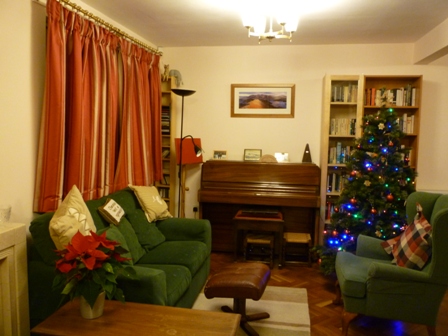
We had a great Christmas. We put the tree up a few days before (we leave it up until 6th January), and also had a poinsettia that a friend had given us.

The nativity scene was a little dwarfed by the knitted wedding figures on the mantelpiece. Obviously there were giant knitted wedding figures at the birth of Christ, not to forget the giant knitted robin too.

And I did get the Christmas cake finished on time! I took a day off work the week before, when I got the marzipan put on, then did the icing just before Christmas. Unfortunately I didn't realise until the last minute that we don't own a holly shaped cutter, so this is my attempt at cutting out holly shapes with a knife (much to the amusement of the OH and my Mum). There were also rude comments about my anaemic green holly leaves and "pink" holly berries. Next year we'll go for e numbers rather than the "natural" food colouring...
 Someone in the US wanted to know what mince pies are. So this is the batch I made to take into work (I decided to make mince pies for everyone instead of doing Christmas cards).
This is just normal shortcrust pastry, made with flour and fat, which has sat in the fridge for a few hours, then rolled out. I didn't make my own mincemeat, so this came in a jar from the supermarket. Mince meat (which used to be savoury with actual meat in it) is a mixture of dried fruit, apple, cinnamon, nutmeg, suet and booze. This sort uses vegetable suet so it's vegetarian.
 You cut the pastry into rounds of two different sizes, and put the bigger ones into a greased Yorkshire pudding tin, then fill with mincemeat and put the smaller round on the top, after wetting the edges of the bottom with water.
 Then bake in the oven. I usually put a cross in the top as well, to let the steam escape, but I forgot this time.

I got the Christmas presents I was making done in time. This is part of a batch of lemon curd.

And a laptop case for Mum's laptop. I made the pattern up as I went along, the yarn is King Cole Riot Chunky, bought when we were on holiday in York. I was a bit worried about whether it would fit, as her laptop is bigger than mine, but, as you can see, it fitted perfectly!
 I lined the case with cat fabric, purchased at Gillie's Fabrics in York.

And what did I receive? Some really cool presents. These ones are shared with the OH - a gravy boat to match our crockery (amusingly we opened presents after Christmas lunch, when we'd had to use the milk jug for the gravy. If only we'd opened the presents earlier we could have used the gravy boat!). Some chocolate. And a kit to make raisin bread, with the dry ingredients, homemade marmalade, a bread tin and recipe included.
 And, for me, some gardening things, including Alan Titchmarsh's The kitchen gardener which I'd been wanting to read. A magic tool for making little pots for seedlings out of newspaper and some seeds.
 And this is my present from the secret santa at knitting group - a set of Chibi needles and some locking stitch markers. Cool or what?!

The on Boxing Day we went for a walk on Staines Moor, which looked suitably desolate and windswept, despite being so close to both Heathrow and the M25! Bit of a contrast with last year when it was so icy we didn't dare leave the house.

 Hope you all had a great Christmas too!
The nativity scene was a little dwarfed by the knitted wedding figures on the mantelpiece. Obviously there were giant knitted wedding figures at the birth of Christ, not to forget the giant knitted robin too.

And I did get the Christmas cake finished on time! I took a day off work the week before, when I got the marzipan put on, then did the icing just before Christmas. Unfortunately I didn't realise until the last minute that we don't own a holly shaped cutter, so this is my attempt at cutting out holly shapes with a knife (much to the amusement of the OH and my Mum). There were also rude comments about my anaemic green holly leaves and "pink" holly berries. Next year we'll go for e numbers rather than the "natural" food colouring...

This is just normal shortcrust pastry, made with flour and fat, which has sat in the fridge for a few hours, then rolled out. I didn't make my own mincemeat, so this came in a jar from the supermarket. Mince meat (which used to be savoury with actual meat in it) is a mixture of dried fruit, apple, cinnamon, nutmeg, suet and booze. This sort uses vegetable suet so it's vegetarian.


I got the Christmas presents I was making done in time. This is part of a batch of lemon curd.

And a laptop case for Mum's laptop. I made the pattern up as I went along, the yarn is King Cole Riot Chunky, bought when we were on holiday in York. I was a bit worried about whether it would fit, as her laptop is bigger than mine, but, as you can see, it fitted perfectly!


And what did I receive? Some really cool presents. These ones are shared with the OH - a gravy boat to match our crockery (amusingly we opened presents after Christmas lunch, when we'd had to use the milk jug for the gravy. If only we'd opened the presents earlier we could have used the gravy boat!). Some chocolate. And a kit to make raisin bread, with the dry ingredients, homemade marmalade, a bread tin and recipe included.


Sunday, December 18, 2011
Books read in November
In no particular order, the slightly eclectic (eccentric?) range of books I got through in November.
The living garden: a place that works with nature by Jane Powers.
This was part of my leaving present from the old job. I read it once over the summer, then read it again! It has a nice, chatty style, with titbits about plants interspersed, with more detail at the end where there are suggestions for planting for different seasons and types of soil. It's a good read, and a great book for dipping into at the end of the day.
Love wins by Rob Bell.
This one's attracted a lot of controversy, but I suspect from people who haven't actually read it. The style is a little annoying - lots of tiny paragraphs with big spaces inbetween in quite a big font, as is the questioning tone, but it doesn't actually say the things it's been accused of (heresy, for instance). It is good for making you stop and think, which is probably what's scared some people away from it? Should be compulsory reading for hellfire-and-damnation-style preachers everywhere, but they'd probably spontaneously combust...
The good parents by Joan London
This was a random choice from the "quick picks" selection by the issue terminal in the library. It follows Maya, an 18 year old Australian, who disappears following the death of her boss' wife. And it also follows her parents search for her, which takes them back through significant parts of their lives. I found it very compelling. One of those books when you actively look forward to the commute as you want to read some more of it. It was also nice to read a book that wasn't set in either Britain or America! There are some incredibly evocative descriptions of the country. I hadn't read anything by Joan London before, but I've now reserved Gilgamesh from the library.
How to be a woman by Caitlin Moran
This seemed to be compulsory commuting reading for a while - everyone (who's female) was reading it on the train! The title also mystified the OH, who pointed out that he thought I'd already know how to be a woman. She didn't say anything I didn't know already, and some of the assumptions were a bit annoying (no, I've never liked wearing heels, unlike apparently most women, surely that's not true? No, I haven't been planning my wedding since I was a toddler) but I liked the way she told things. Some parts are particularly graphic - which did nearly give me the giggles on the train as I wondered how many of the Very Serious Looking other commuters reading the same book were reading the same section...
Give me time by the Chartered Institute of Personnel & Development
As the new job is a lot busier than the old one (where we actually had time to stop and have a tea break at 11 and 4 every day, complete with giant teapot) I thought I'd get something from the library at work about time management. This one is quite easy to dip in and out of, and also up to date (the first one I got out had been published in 2000 and felt the need to explain what email is (!?!?!) and thought the answer to all your problems was a fax machine). There are some very sensible parts of it - working out what aspects of your job (or your life) you can change and what you don't have control over, as well as working out what times of the day you function best, and then planning your time around that. It sounds obvious but I hadn't stopped to think about how the flexi-time in the new job helps me with this. I now work earlyish hours (usually around 8.30 - 4.30) whereas some of my colleagues work 10 - 6, or 8 - 4. It's made me stop bombarding them with questions at 10 when they arrive for work (because they're barely awake) but has also given me ammunition when someone suggests that 4.30 is a great time for a meeting... Apparently delegating is also key, although I suspect this is less easy if you're at home without anyone to delegate to?!
The living garden: a place that works with nature by Jane Powers.
This was part of my leaving present from the old job. I read it once over the summer, then read it again! It has a nice, chatty style, with titbits about plants interspersed, with more detail at the end where there are suggestions for planting for different seasons and types of soil. It's a good read, and a great book for dipping into at the end of the day.
Love wins by Rob Bell.
This one's attracted a lot of controversy, but I suspect from people who haven't actually read it. The style is a little annoying - lots of tiny paragraphs with big spaces inbetween in quite a big font, as is the questioning tone, but it doesn't actually say the things it's been accused of (heresy, for instance). It is good for making you stop and think, which is probably what's scared some people away from it? Should be compulsory reading for hellfire-and-damnation-style preachers everywhere, but they'd probably spontaneously combust...
The good parents by Joan London
This was a random choice from the "quick picks" selection by the issue terminal in the library. It follows Maya, an 18 year old Australian, who disappears following the death of her boss' wife. And it also follows her parents search for her, which takes them back through significant parts of their lives. I found it very compelling. One of those books when you actively look forward to the commute as you want to read some more of it. It was also nice to read a book that wasn't set in either Britain or America! There are some incredibly evocative descriptions of the country. I hadn't read anything by Joan London before, but I've now reserved Gilgamesh from the library.
How to be a woman by Caitlin Moran
This seemed to be compulsory commuting reading for a while - everyone (who's female) was reading it on the train! The title also mystified the OH, who pointed out that he thought I'd already know how to be a woman. She didn't say anything I didn't know already, and some of the assumptions were a bit annoying (no, I've never liked wearing heels, unlike apparently most women, surely that's not true? No, I haven't been planning my wedding since I was a toddler) but I liked the way she told things. Some parts are particularly graphic - which did nearly give me the giggles on the train as I wondered how many of the Very Serious Looking other commuters reading the same book were reading the same section...
Give me time by the Chartered Institute of Personnel & Development
As the new job is a lot busier than the old one (where we actually had time to stop and have a tea break at 11 and 4 every day, complete with giant teapot) I thought I'd get something from the library at work about time management. This one is quite easy to dip in and out of, and also up to date (the first one I got out had been published in 2000 and felt the need to explain what email is (!?!?!) and thought the answer to all your problems was a fax machine). There are some very sensible parts of it - working out what aspects of your job (or your life) you can change and what you don't have control over, as well as working out what times of the day you function best, and then planning your time around that. It sounds obvious but I hadn't stopped to think about how the flexi-time in the new job helps me with this. I now work earlyish hours (usually around 8.30 - 4.30) whereas some of my colleagues work 10 - 6, or 8 - 4. It's made me stop bombarding them with questions at 10 when they arrive for work (because they're barely awake) but has also given me ammunition when someone suggests that 4.30 is a great time for a meeting... Apparently delegating is also key, although I suspect this is less easy if you're at home without anyone to delegate to?!
Thursday, October 20, 2011
Birthday!
Coincidentally I've taken the week off work, and it just happened to have my birthday in it! The OH has had a week off too, and we have been catching up on stuff at home, having a new wall built and things like that.
My birthday itself was cool, we went out for a meal the night before, as I had knitting group the evening of my birthday (you know, priorities).
We had a trip to the garden centre to buy spiky plants to plant along a boundary wall. This is me with the spikiest holly I have ever seen, it's called "Ilex Ferox" for good reason. Although it's English name is the rather cute "Silver Hedgehog Holly". It's to go with the (female) holly we've already got as this one is male.
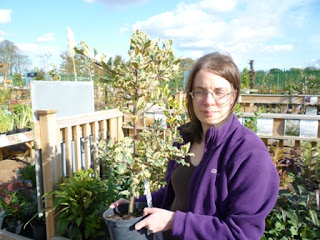
And birthday presents! The OH bought me the slow cooking recipe book as I've had it out of the library for about 3 months now. And I asked for the other recipe book, the Dairy book of home cookery (as delivered by the milkman), as I used to use the previous edition of it, which belonged to my Mum, all the time.
My great aunts sent me the Archers Addicts map of Ambridge, which used to belong to my Gran, so it's come full circle now. I'm finding it very useful for the back story for some of the characters as I've been listening for about six years.
And a skein of Manos Wool Clasica and some homemade bath teabags from my brother and SIL (although I suspect she made them as I can't imagine my brother doing that!).
 And, of course, lots of cards from friends around the world - thank you!
I've spent some time this week sorting out photos and catching up with blog reading. So there might be some more posts from me fairly soon.
My birthday itself was cool, we went out for a meal the night before, as I had knitting group the evening of my birthday (you know, priorities).
We had a trip to the garden centre to buy spiky plants to plant along a boundary wall. This is me with the spikiest holly I have ever seen, it's called "Ilex Ferox" for good reason. Although it's English name is the rather cute "Silver Hedgehog Holly". It's to go with the (female) holly we've already got as this one is male.

And birthday presents! The OH bought me the slow cooking recipe book as I've had it out of the library for about 3 months now. And I asked for the other recipe book, the Dairy book of home cookery (as delivered by the milkman), as I used to use the previous edition of it, which belonged to my Mum, all the time.
My great aunts sent me the Archers Addicts map of Ambridge, which used to belong to my Gran, so it's come full circle now. I'm finding it very useful for the back story for some of the characters as I've been listening for about six years.
And a skein of Manos Wool Clasica and some homemade bath teabags from my brother and SIL (although I suspect she made them as I can't imagine my brother doing that!).

I've spent some time this week sorting out photos and catching up with blog reading. So there might be some more posts from me fairly soon.
Monday, October 10, 2011
Books read in the last couple of months
(or how I attempted to keep Surrey libraries going single-handedly).
This was meant to be a post about books read in August. But now it's October and I'm getting more reading time on the commute to work so my list of books read is getting huge...
This is more list than review!
So, this is what I read in August. The book titles link through to LibraryThing, just cos I think it's fab.
Wolf Hall by Hilary Mantel
I quite enjoyed this one, I thought the portrayal of Henry VIII's court and factions excellent, but it does go on for a looonnnnngggg time. And it weighs a ton, so it only got commuted with once. So far, the one and only book that has made me think about having a Kindle.
A vintage affair by Isabel Wolff
A fun read. Has those annoying things about chick lit. (why does the heroine always have two men interested in her, that never happens in real life?! Why does one of the men always have twinkly eyes?!). Fun descriptions of vintage clothing.Good for commuting reading.
Murder is binding by Lorna Barratt
Bookmarked for death by Lorna Barratt
Murder mysteries set in a murder mystery bookshop (yes, really). Again, a fun read but not great works of literature.
Read in September:
The girl with the dragon tattoo by Stieg Larsson
The girl who played with fire by Stieg Larsson
The girl who kicked the hornets' nest by Stieg Larsson
Didn't intend to read them in a row in the space of just over a fortnight, but that's what happened. These are very compelling! I found myself wishing for a longer commute just so I could keep reading! Very highly recommended. They are in translation, but it's been done very well so you can't tell, apart from occasional bits where there's some detail to explain how something or other happens in Sweden. I enjoyed the insights into another society, and although there is a lot about the problems of Sweden's social welfare system, I still thought it sounded better than here... If only Larsson had lived longer, as i would have loved to have read more books by him.
People of the book by Geraldine Brooks
Really enjoyed this one. It's about the Sarajevo Haggadah, the story of a six hundred year old book and makes the world of rare books look far more glamorous than it actually is. Well, I've certainly never jet-setted round the world tracking down provenance leads anyway.
Read in October:
The prince of mist by Carlos Ruiz Zafon
This is meant to be scary, but it isn't nearly as chilling as others I've read. It's written for children and is in translation (which shows in places) and the scary bits are a bit too much obviously intended to be scary. The action moves too fast which makes it a little less believable too.
Treasures of Durham University Library ed. by Richard Gameson
Oooh nice books!
The Royal Horticultural Society: Bulbs
Good pictures and idiot's guide to bulb planting (very useful for me).
How to garden: perennial plants by Alan Titchmarsh
Another idiot's guide to gardening. I found it really useful as it focusses on a few plants rather than the overwhelming numbers you get in other gardening books (the sort that assume you know what you're doing). Probably not for someone who knows what they're doing...
This was meant to be a post about books read in August. But now it's October and I'm getting more reading time on the commute to work so my list of books read is getting huge...
This is more list than review!
So, this is what I read in August. The book titles link through to LibraryThing, just cos I think it's fab.
Wolf Hall by Hilary Mantel
I quite enjoyed this one, I thought the portrayal of Henry VIII's court and factions excellent, but it does go on for a looonnnnngggg time. And it weighs a ton, so it only got commuted with once. So far, the one and only book that has made me think about having a Kindle.
A vintage affair by Isabel Wolff
A fun read. Has those annoying things about chick lit. (why does the heroine always have two men interested in her, that never happens in real life?! Why does one of the men always have twinkly eyes?!). Fun descriptions of vintage clothing.Good for commuting reading.
Murder is binding by Lorna Barratt
Bookmarked for death by Lorna Barratt
Murder mysteries set in a murder mystery bookshop (yes, really). Again, a fun read but not great works of literature.
Read in September:
The girl with the dragon tattoo by Stieg Larsson
The girl who played with fire by Stieg Larsson
The girl who kicked the hornets' nest by Stieg Larsson
Didn't intend to read them in a row in the space of just over a fortnight, but that's what happened. These are very compelling! I found myself wishing for a longer commute just so I could keep reading! Very highly recommended. They are in translation, but it's been done very well so you can't tell, apart from occasional bits where there's some detail to explain how something or other happens in Sweden. I enjoyed the insights into another society, and although there is a lot about the problems of Sweden's social welfare system, I still thought it sounded better than here... If only Larsson had lived longer, as i would have loved to have read more books by him.
People of the book by Geraldine Brooks
Really enjoyed this one. It's about the Sarajevo Haggadah, the story of a six hundred year old book and makes the world of rare books look far more glamorous than it actually is. Well, I've certainly never jet-setted round the world tracking down provenance leads anyway.
Read in October:
The prince of mist by Carlos Ruiz Zafon
This is meant to be scary, but it isn't nearly as chilling as others I've read. It's written for children and is in translation (which shows in places) and the scary bits are a bit too much obviously intended to be scary. The action moves too fast which makes it a little less believable too.
Treasures of Durham University Library ed. by Richard Gameson
Oooh nice books!
The Royal Horticultural Society: Bulbs
Good pictures and idiot's guide to bulb planting (very useful for me).
How to garden: perennial plants by Alan Titchmarsh
Another idiot's guide to gardening. I found it really useful as it focusses on a few plants rather than the overwhelming numbers you get in other gardening books (the sort that assume you know what you're doing). Probably not for someone who knows what they're doing...
Friday, September 23, 2011
Trip oop north #1
Can someone please explain where on earth 2/3rds of September just disappeared off to?! This has been one very mad month. Between August and September I've had three incomplete weeks at work, thanks to taking a Friday and the Tuesday after the bank holiday to go to Greenbelt, then the week after I spent three days oop north at a conference for work. Then I had a WHOLE FIVE DAYS (shock horror) at work, then we set off on holiday. So some of the time has been a little bitty. The weekends have been mad. I got back from the conference at 10pm on the Friday, then lurched straight off to the church open day on the Saturday (having baked some chocolate brownies to sell on the Fair trade stall in the meantime), then hurtled straight into the church patronal festival the next morning, then off to knitting group for the afternoon. Gardening has got a bit behind as I haven't been at home to do any.
Fortunately I got the OH's jumper finished in time for his birthday.
 He has got a head really.
 I'm rather pleased with it, and I love the pattern - very easy to follow and well-written, and easy to adapt to particular quirks so I altered the length of the body and sleeves to his preferences.
And sewed a label in the back.

The slow cooker has come in very handy (again). This is lamb casserole.

The conference (held in Durham, with a trip to Newcastle) was most impressive. We stayed in Collingwood at Durham University. Halls of residence have moved on a bit since my day, not only was my room en suite, but it even came complete with its own recycling crate, and a little shelf with aerial socket to put a TV on! Back in my student days in the Dark Ages you had to carry your recycling all the way to the supermarket car park to find a recycling bin. And whilst I did have a TV in my room at university, it had to sit on a wobbly little table supplied by me, with a wobbly aerial sat on top of it.
Most impressively, the halls also had a "green" policy, with loads of stuff about reducing energy use, the food miles of the food served up in the dining hall (very tasty it was too) and even the conference packs provided in the rooms were all fair trade! Apparently there is some kind of competition between the colleges about which has the lowest carbon emissions.
 We had various talks during the days at the conferences, plus a reception at the Oriental Museum one night. This is the sort of place where I'd love to spend more time looking round, and I'd recommend a visit if you're in the area.

and a reception at the Botanic Gardens another night. Again, I'd have loved to have seen more of this than I did, the bit I saw looked beautiful.

One morning we took a trip up to Newcastle on a bus, to visit Seven Stories - the centre for children's literature. This is one of the coolest places I've ever been, and there was plenty on the, er, seven storeys, of the building to keep adults and children alike entertained (don't worry, there is a lift). The exhibitions managed to combine interesting stuff for older people (like me), with more kid-friendly stuff, and there is a massive creating space for children at the bottom storey, as well as the biggest selection of children's books in the bookshop that I've ever seen in one place. I loved the exhibition about Puffin books, and found displays from some of my childhood favourites.
Plus, they had a display about what happens to their book collections when they arrive on site, which included something that I think should go into my job description:

See, I'm an expert and a bit like a detective!
It was also fun driving around Newcastle on the bus, and admiring the views.


including a glimpse of the Angel of the North as we approached the city.

On the final day of the conference we got to visit the new exhibition space at Palace Green (the university special collections library), where there was a display of Treasures of the University. I also trotted off for a quick trip into the cathedral.

It was a great trip, I only wish I'd had more time to visit places in Durham - I did return to Newcastle with the OH this week whilst we were on holiday, more in a future blog post!
Fortunately I got the OH's jumper finished in time for his birthday.

And sewed a label in the back.

The slow cooker has come in very handy (again). This is lamb casserole.

The conference (held in Durham, with a trip to Newcastle) was most impressive. We stayed in Collingwood at Durham University. Halls of residence have moved on a bit since my day, not only was my room en suite, but it even came complete with its own recycling crate, and a little shelf with aerial socket to put a TV on! Back in my student days in the Dark Ages you had to carry your recycling all the way to the supermarket car park to find a recycling bin. And whilst I did have a TV in my room at university, it had to sit on a wobbly little table supplied by me, with a wobbly aerial sat on top of it.
Most impressively, the halls also had a "green" policy, with loads of stuff about reducing energy use, the food miles of the food served up in the dining hall (very tasty it was too) and even the conference packs provided in the rooms were all fair trade! Apparently there is some kind of competition between the colleges about which has the lowest carbon emissions.


and a reception at the Botanic Gardens another night. Again, I'd have loved to have seen more of this than I did, the bit I saw looked beautiful.

One morning we took a trip up to Newcastle on a bus, to visit Seven Stories - the centre for children's literature. This is one of the coolest places I've ever been, and there was plenty on the, er, seven storeys, of the building to keep adults and children alike entertained (don't worry, there is a lift). The exhibitions managed to combine interesting stuff for older people (like me), with more kid-friendly stuff, and there is a massive creating space for children at the bottom storey, as well as the biggest selection of children's books in the bookshop that I've ever seen in one place. I loved the exhibition about Puffin books, and found displays from some of my childhood favourites.
Plus, they had a display about what happens to their book collections when they arrive on site, which included something that I think should go into my job description:

See, I'm an expert and a bit like a detective!
It was also fun driving around Newcastle on the bus, and admiring the views.


including a glimpse of the Angel of the North as we approached the city.

On the final day of the conference we got to visit the new exhibition space at Palace Green (the university special collections library), where there was a display of Treasures of the University. I also trotted off for a quick trip into the cathedral.

It was a great trip, I only wish I'd had more time to visit places in Durham - I did return to Newcastle with the OH this week whilst we were on holiday, more in a future blog post!
Sunday, July 24, 2011
Room by Emma Donoghue
When you read the synopsis of this novel, it doesn't exactly encourage you to pick it up and start reading. It sounds massively depressing for a start - the story is of a five year old boy and his Mum who are being held captive by a man (who also fathered the boy) in Room. And it's narrated by the five year old. Both of those things made me thing that it wouldn't be very good, and that it would also be very dark to read.
Not a bit of it. I soon got into the style of the writing, and, coming from the child's perspective makes it an entertaining read. This is a kid who has never been outside the room he was born in so how he views his world and what happens in it is highly interesting, and amusing in places. Plus, because it's from his perspective, there's nothing graphic actually in the book, although cleary some horrendous stuff has been going on. Yes, there are some dark parts, and some thriller-like parts that had me on tenterhooks, but there are also many heartening cheerful parts. I was overwhelmed by the ingenuity of the Mum, who has managed to bring her son up in as healthy a way as she can manage and educate him with the limited resources available to her. And by the ingenuity of the author, who had obviously put a massive amount of thought into both the circumstances of the main characters' lives and also what it would be like for the boy once he is outside the room. And I'd better not say any more, else I'll give the plot away! ;-)
I read this very very fast, in slightly over a day. It's one of those unputdownable books.
I had a busy week last week. The new job is fantastic. All I had hoped it would be and I've had a lovely time. Even the daily commute wasn't too bad, although I was quite tired by the end of the week.
It was nice having extra time for reading and knitting on the train (about 1.5 hours a day now!) and so far I've had a seat on every train and tube I've been on.
I'm currently reading Wolf Hall by Hilary Mantel and A vintage affair by Isabel Wolff, so I'll review those once I've finished them. Wolf Hall is taking a while as it's really too heavy to take on the train so I'm only reading it at home.
Knitting-wise, I've finished some more blanket KAL squares, and am actually waiting for next month's patterns to be released instead of frantically trying to get squares finished before the end of the month!
I managed to forget to cross one of the cables over in the cabled square and then also forgot that I have the Knit fix book which tells you how to fix this...


That's all for now. With the new job I'm finding that I have less time for blog reading and catching up with Ravelry and Facebook, so bear with me!
Not a bit of it. I soon got into the style of the writing, and, coming from the child's perspective makes it an entertaining read. This is a kid who has never been outside the room he was born in so how he views his world and what happens in it is highly interesting, and amusing in places. Plus, because it's from his perspective, there's nothing graphic actually in the book, although cleary some horrendous stuff has been going on. Yes, there are some dark parts, and some thriller-like parts that had me on tenterhooks, but there are also many heartening cheerful parts. I was overwhelmed by the ingenuity of the Mum, who has managed to bring her son up in as healthy a way as she can manage and educate him with the limited resources available to her. And by the ingenuity of the author, who had obviously put a massive amount of thought into both the circumstances of the main characters' lives and also what it would be like for the boy once he is outside the room. And I'd better not say any more, else I'll give the plot away! ;-)
I read this very very fast, in slightly over a day. It's one of those unputdownable books.
I had a busy week last week. The new job is fantastic. All I had hoped it would be and I've had a lovely time. Even the daily commute wasn't too bad, although I was quite tired by the end of the week.
It was nice having extra time for reading and knitting on the train (about 1.5 hours a day now!) and so far I've had a seat on every train and tube I've been on.
I'm currently reading Wolf Hall by Hilary Mantel and A vintage affair by Isabel Wolff, so I'll review those once I've finished them. Wolf Hall is taking a while as it's really too heavy to take on the train so I'm only reading it at home.
Knitting-wise, I've finished some more blanket KAL squares, and am actually waiting for next month's patterns to be released instead of frantically trying to get squares finished before the end of the month!
I managed to forget to cross one of the cables over in the cabled square and then also forgot that I have the Knit fix book which tells you how to fix this...


That's all for now. With the new job I'm finding that I have less time for blog reading and catching up with Ravelry and Facebook, so bear with me!
Thursday, June 16, 2011
The Help by Kathryn Stockett
The Help is a pretty amazing book. It's one of the few I've read recently that I literally haven't been able to put down. It's about three women in 1960s Mississippi - Skeeter, who is white and has just finished college, and Aibileen and Minny who are both black maids. Each has their own problems, Skeeter has a mother who is very keen to get her married off well as soon as possible, as well as some pretty unbearable "friends". Aibileen, who works for one of Skeeter's "friends", and Minny have the problem of being black in an incredibly unequal society. This is what gripped me and totally appalled me - this is only 50 years ago, after all. The white and black people, although they can now use the same buses, thanks to Rosa Parks, have separate schools, housing areas, libraries, even different toilets for the maids in the white person's house. How on earth anybody ever thought this made any sense at all is beyond me. What seems worse (?) than the visible racism of this though, is the patronising attitude of most of the white employers - that they know best, that things like separate toilets are a good thing (eh?), even though the black maids are trusted with the care of the white children.
The action is narrated in turn by the three characters, giving an insight into the different perspectives. Of course, I had the advantage of knowing what would happen in the end - and several times I longed to be able to whisper to the characters that 50 years later there would be a black President. What is also shocking, is the way that anyone who stands up against the inequalities risks their life. Several times in the story someone gets beaten up and their life changed forever, just because they dared to do something like go into a white shop when they're black. Skeeter begins a project to publish the stories of the black maids, and it is clear that even by talking to her like this, the maids are risking everything.
So, I recommend reading this. It's definitely not in the "To kill a mocking bird" classics category but it is very very readable as well as shocking. This is the copy of the book I read:
 Apparently the book was published in the US with a different image on the cover.
The action is narrated in turn by the three characters, giving an insight into the different perspectives. Of course, I had the advantage of knowing what would happen in the end - and several times I longed to be able to whisper to the characters that 50 years later there would be a black President. What is also shocking, is the way that anyone who stands up against the inequalities risks their life. Several times in the story someone gets beaten up and their life changed forever, just because they dared to do something like go into a white shop when they're black. Skeeter begins a project to publish the stories of the black maids, and it is clear that even by talking to her like this, the maids are risking everything.
So, I recommend reading this. It's definitely not in the "To kill a mocking bird" classics category but it is very very readable as well as shocking. This is the copy of the book I read:

Sunday, June 12, 2011
Second honeymoon part 1
For our first wedding anniversary we decided to return to Stratford-upon-Avon for another week's holiday. We went there on honeymoon, but only got 5 nights away due to difficulties getting time off work, so didn't get to half the places we intended to. We booked to stay in the same flat this year as we'd liked it so much.
We travelled down on the Saturday and found a lovely independent bookshop in Thame on the way, called the Book House. It has two puffins sat outside its front door, one called the Fat Puffin, one called Muffin! I would love to live near a shop like this - it had a great range of books, including an enormous children's section and a little garden you could sit in too. I bought a copy of the Morville Hours by Katherine Swift too, a book I've been meaning to read for ages.

On Sunday I went to church at Holy Trinity, Stratford, where Shakespeare is buried. It was fun going somewhere different to my usual church - at this one they sang the hymns twice as fast as at home!

Then we went to The Lunt Roman fort, just outside Coventry. c. 2000 years ago this was the frontier of the Roman empire (slightly hard to imagine now, with the traffic noise from the A46!). But it's a fun sight, lacking all the usual tourist amenities (no overpriced tourist tat on sale, no extortionate admission fee but there are loos and a few picnic benches). Bits of a mock Roman fort have been built on some parts of the archaeological dig, so you can climb on the ramparts and pretend to be a Roman legionary, and go in the gyrus (a horse training ring, this is the only known example in Britain).

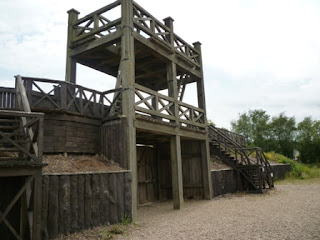
And on to Coombe Abbey country park, once the site of a monastery until the Reformation in the 16th century, then a country house, with grounds designed by Capability Brown in the 18th century, the park now belongs to Coventry City Council, although the house itself has been sold off and turned into a hotel. And it's really lovely. Although the part around the car parks and visitor centre are quite crowded, it's easy to get away from those into peaceful woodland. You can walk part way round the lake, and visit a bird hide (parts of the site are designated as a Site of Special Scientific Interest, and there are lots of herons nesting). There are formal gardens and a deer park to explore (but we only saw some sheep). There is also the pleasant and reasonably priced herons café on site, where we had lunch, and later a cup of tea.


On Monday, we did some shopping in Stratford town centre, then went for a walk along the River Avon, up one way, crossed over, then walked back along the other bank, stopped to watch some barges go through a lock on the way. One barge was called "Cheeky Monkey" and had monkeys in the window...

Tuesday we headed over to visit Charlecote Park, a National Trust property not far from Stratford. It dates from the 12th century, although most of it is mock Tudor (actually 19th century) in appearance. The rooms are huge and there is a restaurant in what was the Orangery, as well as a garden centre (at which I may have indulged).

We then drove on into Warwick, where we had a cup of tea conveniently close to Warwick Wools and I bought some Sirdar Simply Recycled DK to make one of the patterns from the summer Interweave Knits. We also visited Warwick Books, where I picked up an Alan Titchmarsh gardening book. We also had a look in Warwick Museum - which was rather good. Small and free, but well thought out with displays aimed at all age groups. If you're in the area it's well worth a look. I took a picture of a plesiosaur, which died out about 65 million years ago, as it reminded me of reading Remarkable Creatures for reading group last month.


Then it was back to the holiday flat ready for an outing to the Royal Shakespeare Theatre to see the Merchant of Venice. Unfortunately the OH had done his back in that morning so I ended up having to go on my own. And WHAT a disappointment. Bad signage meant I couldn't find the entrance I was supposed to use, then I was sold a programme for a different play (despite showing the seller my ticket), by the time I'd sorted that out and found the entrance the play had started and they'd given my seat(s) to someone else and I got shoved behind a pillar! Then it turned out to be the biggest load of complete rubbish I think I've ever seen at the theatre - involving an Elvis impersonator, Batman, Robin and a blue teddy bear cavorting round the stage. I left during the interval...

To be continued....
We travelled down on the Saturday and found a lovely independent bookshop in Thame on the way, called the Book House. It has two puffins sat outside its front door, one called the Fat Puffin, one called Muffin! I would love to live near a shop like this - it had a great range of books, including an enormous children's section and a little garden you could sit in too. I bought a copy of the Morville Hours by Katherine Swift too, a book I've been meaning to read for ages.

On Sunday I went to church at Holy Trinity, Stratford, where Shakespeare is buried. It was fun going somewhere different to my usual church - at this one they sang the hymns twice as fast as at home!

Then we went to The Lunt Roman fort, just outside Coventry. c. 2000 years ago this was the frontier of the Roman empire (slightly hard to imagine now, with the traffic noise from the A46!). But it's a fun sight, lacking all the usual tourist amenities (no overpriced tourist tat on sale, no extortionate admission fee but there are loos and a few picnic benches). Bits of a mock Roman fort have been built on some parts of the archaeological dig, so you can climb on the ramparts and pretend to be a Roman legionary, and go in the gyrus (a horse training ring, this is the only known example in Britain).


And on to Coombe Abbey country park, once the site of a monastery until the Reformation in the 16th century, then a country house, with grounds designed by Capability Brown in the 18th century, the park now belongs to Coventry City Council, although the house itself has been sold off and turned into a hotel. And it's really lovely. Although the part around the car parks and visitor centre are quite crowded, it's easy to get away from those into peaceful woodland. You can walk part way round the lake, and visit a bird hide (parts of the site are designated as a Site of Special Scientific Interest, and there are lots of herons nesting). There are formal gardens and a deer park to explore (but we only saw some sheep). There is also the pleasant and reasonably priced herons café on site, where we had lunch, and later a cup of tea.


On Monday, we did some shopping in Stratford town centre, then went for a walk along the River Avon, up one way, crossed over, then walked back along the other bank, stopped to watch some barges go through a lock on the way. One barge was called "Cheeky Monkey" and had monkeys in the window...

Tuesday we headed over to visit Charlecote Park, a National Trust property not far from Stratford. It dates from the 12th century, although most of it is mock Tudor (actually 19th century) in appearance. The rooms are huge and there is a restaurant in what was the Orangery, as well as a garden centre (at which I may have indulged).

We then drove on into Warwick, where we had a cup of tea conveniently close to Warwick Wools and I bought some Sirdar Simply Recycled DK to make one of the patterns from the summer Interweave Knits. We also visited Warwick Books, where I picked up an Alan Titchmarsh gardening book. We also had a look in Warwick Museum - which was rather good. Small and free, but well thought out with displays aimed at all age groups. If you're in the area it's well worth a look. I took a picture of a plesiosaur, which died out about 65 million years ago, as it reminded me of reading Remarkable Creatures for reading group last month.


Then it was back to the holiday flat ready for an outing to the Royal Shakespeare Theatre to see the Merchant of Venice. Unfortunately the OH had done his back in that morning so I ended up having to go on my own. And WHAT a disappointment. Bad signage meant I couldn't find the entrance I was supposed to use, then I was sold a programme for a different play (despite showing the seller my ticket), by the time I'd sorted that out and found the entrance the play had started and they'd given my seat(s) to someone else and I got shoved behind a pillar! Then it turned out to be the biggest load of complete rubbish I think I've ever seen at the theatre - involving an Elvis impersonator, Batman, Robin and a blue teddy bear cavorting round the stage. I left during the interval...

To be continued....
Subscribe to:
Posts (Atom)